Bassen is a five-year-old adult dog, but he acts like an Italian groom who just wants to stay home with his mama forever. If Bassen were a human, he would never leave home and would just be happy to sit at home and play yatzy with his mom every night.
In short, I have a dog who unfortunately suffers from separation anxiety, and we have been struggling with it for five years now. He has been my own little, curly anklet, because I could never leave the house for even a quarter of an hour without taking him with me or having arranged for him to be looked after.
And as with so much else in dog training, the cause of problem behavior lies 99% with the owner.
When I brought the 8-week-old puppy home, I almost immediately started house training him on my own, in small doses. And it went pretty well, but after only two weeks I had the misfortune of falling down the stairs and breaking my foot.
Living alone on the 3rd floor with a broken foot was a lot of challenges in itself, and having a puppy in the house didn't make those challenges any less. As inexperienced with dogs as I was, I thought that the home training alone would have to wait until I could walk on my foot again.
How often have I cursed myself for that decision. Because when the crutches were gone after two months, Bassen had gotten used to me always being there, and he had never tried to be alone for more than five seconds.
I tried everything – and that was probably a problem in itself, because the dog became more and more confused by the many different methods I tried.
I have received countless “good” advice, but I can only say: All dogs are different, and what works for one, does not necessarily work for another. It took a long time before I found what worked for my dog. And then comes the long, long hard pull. Practice practice practice! Every single day! And in tiny steps and with constant setbacks.
It may sound crazy, but the fact that my dog has now – at the age of five – managed to be able to be alone for 4 ½ hours is absolutely amazing in my world, and I am proud as a pope, both of him and of me.
So my only advice to others with the same problem – hang in there!
Even an old dog can learn new tricks.
About this week's blogger:
Heidi Christiansen is a happy dog owner of the 5-year-old mini poodle Basse, who is primarily a comfort and companion dog.
She works as a translator and therefore has plenty of time with her beautiful, energetic bundle of energy.
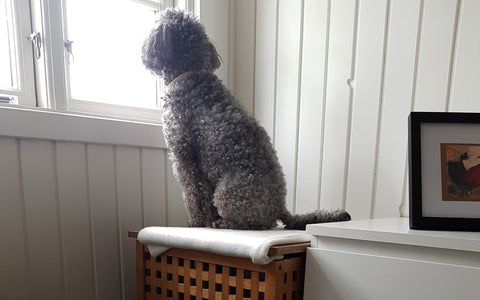
Waiting for mom – alone and miserable
Bassen is a five-year-old adult dog, but he acts like an Italian groom who just wants to stay home with his mama forever. If Bassen were a human, he would never leave home and would just be happy to sit at home and play yatzy with his mom every night.
In short, I have a dog who unfortunately suffers from separation anxiety, and we have been struggling with it for five years now. He has been my own little, curly anklet, because I could never leave the house for even a quarter of an hour without taking him with me or having arranged for him to be looked after.
And as with so much else in dog training, the cause of problem behavior lies 99% with the owner.
When I brought the 8-week-old puppy home, I almost immediately started house training him on my own, in small doses. And it went pretty well, but after only two weeks I had the misfortune of falling down the stairs and breaking my foot.
Living alone on the 3rd floor with a broken foot was a lot of challenges in itself, and having a puppy in the house didn't make those challenges any less. As inexperienced with dogs as I was, I thought that the home training alone would have to wait until I could walk on my foot again.
How often have I cursed myself for that decision. Because when the crutches were gone after two months, Bassen had gotten used to me always being there, and he had never tried to be alone for more than five seconds.
I tried everything – and that was probably a problem in itself, because the dog became more and more confused by the many different methods I tried.
I have received countless “good” advice, but I can only say: All dogs are different, and what works for one, does not necessarily work for another. It took a long time before I found what worked for my dog. And then comes the long, long hard pull. Practice practice practice! Every single day! And in tiny steps and with constant setbacks.
It may sound crazy, but the fact that my dog has now – at the age of five – managed to be able to be alone for 4 ½ hours is absolutely amazing in my world, and I am proud as a pope, both of him and of me.
So my only advice to others with the same problem – hang in there!
Even an old dog can learn new tricks.
About this week's blogger:
Heidi Christiansen is a happy dog owner of the 5-year-old mini poodle Basse, who is primarily a comfort and companion dog.
She works as a translator and therefore has plenty of time with her beautiful, energetic bundle of energy.